

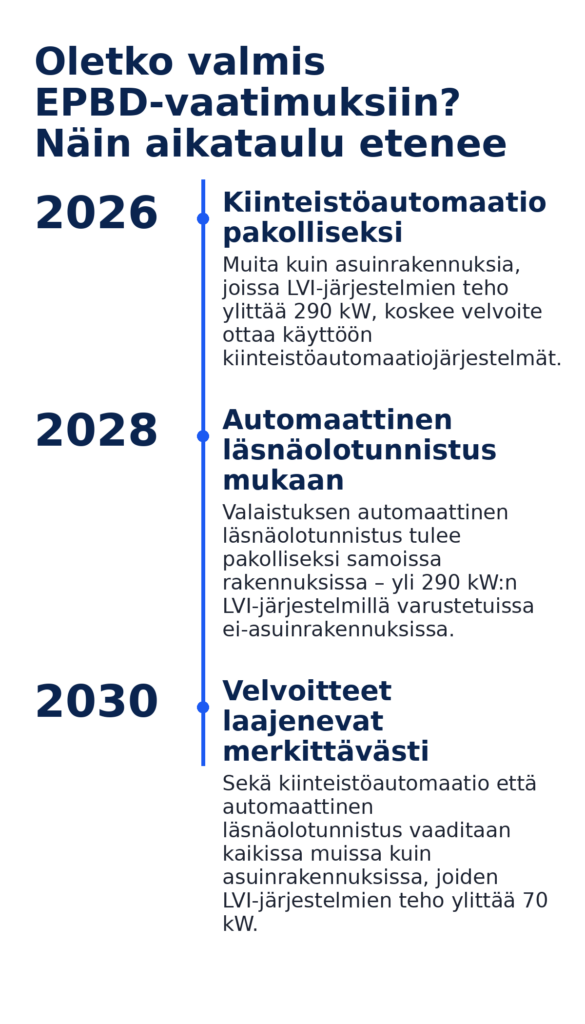
Rakennusten energiatehokkuusdirektiivi EPBD (Energy Performance of Buildings Directive) tuo seuraavien vuosien aikana merkittäviä velvoitteita kiinteistöjen automaatioon ja älykkääseen valaistukseen. Tavoitteena on parantaa rakennusten energiatehokkuutta, pienentää kustannuksia ja vähentää hiilijalanjälkeä – mutta samalla myös lisätä kiinteistöjen turvallisuutta ja käyttömukavuutta.
Rakennusten energiatehokkuusdirektiivi (EPBD) on osa EU:n Fit for 55 -valmiuspakettia, jonka tavoitteena on vähentää EU:n päästöjä vähintään 55 prosentilla vuoteen 2030 mennessä verrattuna vuoden 1990 tasoon. Direktiivin ensisijaisena tavoitteena on parantaa rakennusten energiatehokkuutta ja vähentää kasvihuonekaasupäästöjä, jotta saavutettaisiin päästötön rakennuskanta viimeistään vuonna 2050. Direktiivi tuli voimaan toukokuussa 2024 ja on kansallisesti voimaansaatettava jäsenmaissa 29. toukokuuta 2026 mennessä.
💡 Miksi nämä muutokset kannattaa hoitaa ajoissa?
Aikataulussa pysyminen pienentää riskejä ja välttää kiireellä tehtyjä ratkaisuja
Energiatehokkuus paranee ja kulut pienenevät
Parempi hallinta kiinteistön järjestelmistä
Vähemmän päästöjä, enemmän vastuullisuutta
Tarjoamme selkeän suunnitelman ja kokonaisratkaisun valaistuksen automaation ja läsnäolotunnistuksen toteutukseen. Saat konkreettisen näkymän kustannuksiin, hyötyihin ja aikatauluihin.
👉Kysy lisätietoja tai pyydä arvio omasta kiinteistöstäsi — autamme mielellämme.

Ismo Soinila on uusin vahvistus AD-Luxin myyntitiimissä.
Ismolla on pitkä kokemus sisä- ja ulkovalaistusratkaisusta ja hän palvelee jatkossa kaikkia AD-Luxin asiakkaita. Hänellä on pitkä kokemus valaistuksen suunnittelusta ja erilaisista valaistuksen ohjausratkaisuista.
Ismon yhteystiedot ovat tässä:
puhelinnumero: 050 413 4510
e-mail: ismo.soinila@adlux.fi
Kaikki alkaa nykytilanteen kartoituksesta. Asiantuntijamme kävi kohteessa, ja lähtökohdat olivat selkeät:
💡 Summary
Uusi valaistus ei ole vain energiansäästöä, vaan kokonaisvaltainen parannus työympäristöön: turvallisuus, tehokkuus ja työn laatu nousevat uudelle tasolle. Ihmiset ovat kuitenkin aina keskiössä.
Jos olet kiinnostunut miten asiat voidaan teillä parantaa, ota yhteyttä. Kaikki suunnitelu ja kartoitus on täysin ilmaista. adlux@adlux.fi
AD-Luxin valaisimet valmistetaan ja kootaan omassa tehtaassamme Kaarinassa.
Meille laatu, kotimaisuus ja vastuullisuus eivät ole pelkkiä sanoja – ne ohjaavat kaikkea tekemistämme.
Valaisimien alumiinirungot valmistetaan Mäkelä Alun Joutsenmerkittyä kierrätysalumiinia käyttäen.
Toimistovalaisimissamme hyödynnämme kierrätettyä polypropeenia, joka vähentää muovijätettä ja pienentää hiilijalanjälkeä.
Jokainen valaisin käy läpi tarkan testausprosessin ennen toimitusta.
Varmistamme kytkennät, mittaamme eristysvastukset ja testaamme toiminnan – jokainen meiltä lähtevä valaisin on ollut päällekytkettynä ja testattu käytännössä.
Laatua tukevat myös LEAN-toimintamalli sekä sertifioidut ISO 9001 ja ISO 14001 -laatujärjestelmät.
Olemme ylpeitä suomalaisesta työstä: oman tuotannon valaisimillemme on myönnetty Suomalaisen Työn Liiton Avainlippu.
Se kertoo, että yli puolet valaisimen kustannuksista syntyy kotimaisesta työstä ja materiaaleista.
Komponentit tulevat Philips/Signifyltä Puolasta, mutta kaikki runkomateriaalit ja kokoonpano tehdään Suomessa.
Oman tuotannon lineaarivalaisimet ovat alumiinirunkoisia ja Philips/Signifyn elektroniikalla varustettuja – eliniänodote jopa >100 000 tuntia.
Valoa voidaan ohjata tarkasti linsseillä, ja eri teholuokat tarjoavat valoa 4 000–40 000 luumenin välillä.
Vakiomallimme ovat IP54-luokiteltuja, ja tarvittaessa ne voidaan tiivistää IP65-luokkaan.
Räätälöimme valaisimet tarpeesi mukaan:
Valikoimastamme löytyy kolme teholuokkaa: 15 000 / 30 000 / 60 000 lm, kaikki IP65-luokiteltuja.
Linssivaihtoehdot mahdollistavat valon tarkan suuntauksen – myös vaakasuuntaan, jolloin häikäisy voidaan minimoida esimerkiksi tielle tai naapurustoon.
Tavoitteenamme on kehittää biokomposiitista valmistettu valaisin, joka vie kierrätysasteen vielä pidemmälle.
Jo nyt tuotannossa on AD Green -sarja, jossa käytetään kierrätettyä polypropeenia.
Ekologinen, kevyt ja moderni ratkaisu – ilman kompromisseja valon laadussa.
AD-Luxin oman tuotannon lisäksi tarjoamme myös Signifyn LED-paneelit ja muita laadukkaita valaisinratkaisuja eri kohteisiin.
Tutustu lisää:
👉 www.adlux.fi
Celerpak Oy:n piha on valaistu uusilla AD Zone LUX200 valonheittimillä. Tässä alla näet kuvat toteutuksesta.
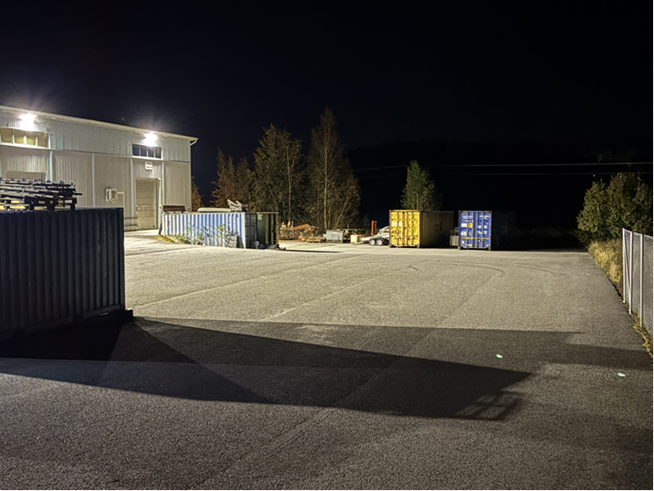
Celerpak Oy on vuonna 2006 perustettu pakkausalan yritys Varsinais-Suomen alueella. Toimitilamme on Raisiossa hyvien kulkuyhteyksien varrella.
Pakkaustuotteet yrityksille sekä yksityisille
Tarjoamme monenlaisia ratkaisuja yrityksenne pakkaustarpeisiin nopeasti ja henkilökohtaisesti, yksilöidysti tai suoraan varastosta. Tarjoamme esimerkiksi meidän valmistamamme:
Toiminta-ajatuksemme ydin on nopea, mutkaton ja ammattitaitoinen palvelu vuosien kokemuksella. Tehokkuutemme painottuu joustavaan piensarjatuotantoon painatuksilla tai ilman, sekä laadukkaisiin raaka-aineisiin.
Sivuillamme on valtavasti tietoa, mikä liittyy valaistukseen ja valaisimiin. Nyt voit kokeilla uutta älybottia, joka vastaa. Voit kysyä mitä tahansa, mikä liittyy jollakin tavalla valaistukseen. Kokeile vaikka. Oikealla alareunassa on logo ja siitä klikkaamalla aukeaa ruutu, johon voi kirjoittaa.
Voit myös jättää yhteystietosi, niin henkilökuntamme ottaa sinuun pikimmiten yhteyttä.

Kokeile kysyä esimerkiksi:
"milloin valo on hyvää"
Tai "kuka oli Edison"
Tekoäly poimii tietenkin tietoja, joita sivuiltamme löytyy, mutta myös muista linkeistä, joita olemme sinne asettaneet tietolähteiksi. Sitä ei botti osannut vastata, kun kysyimme "mikä on paras perunamuusi".
Nyt siihen on oivallinen mahdollisuus. Vanhasta valaisimesta voidaan purkaa sisuskalut pois ja valaisin varustetaan moderneilla ledeillä.
Tällä tavalla: (kuva on omasta toimistostamme, jossa oli vanhoja loisteputkivalaisimia)
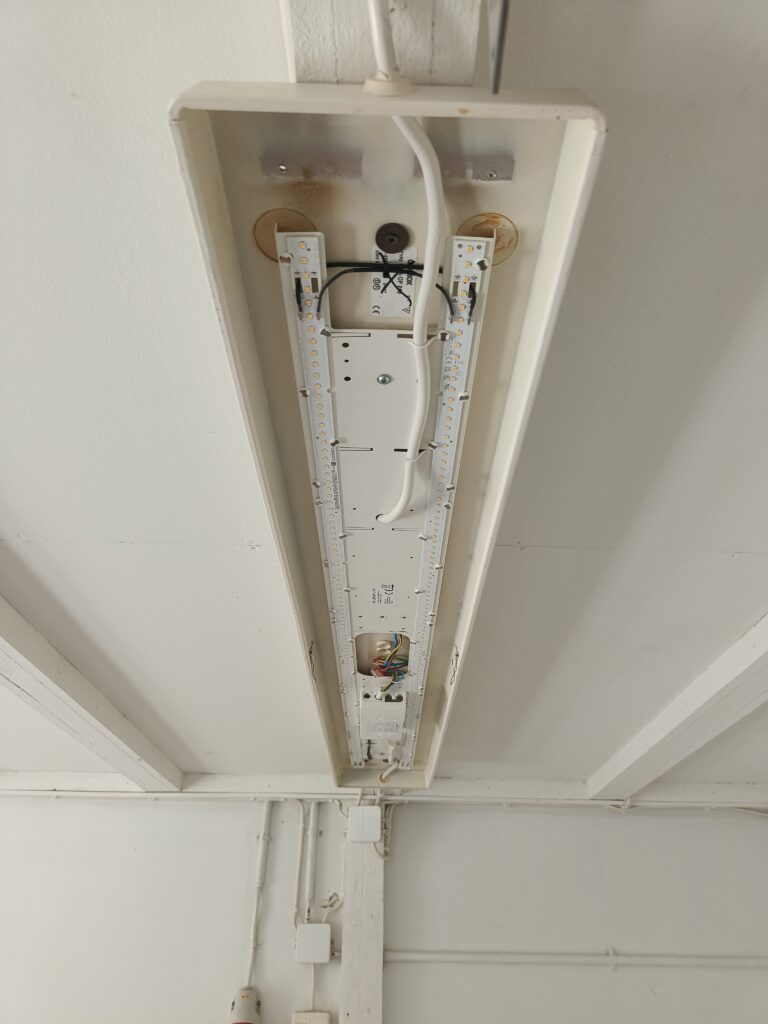
Ei tarvita muuta kuin kupu takaisin ja johan tulee paljon valoa!
Asennus on nopeaa ja uutta kaapelointia ei välttämättä tarvita. Toki sähköasentajaa tarvitaan, mutta sen jälkeen tämä ratkaisu toimii vuosikausia.
Tästä näet sähkönumeroiden kautta tarkemmat tiedot valaisimesta:
https://www.sahkonumerot.fi/4325891
Valaisin voidaan valmistaa ON-OFF valaisimena, DALI-valaisimena tai Philipsin MasterConnect -valaisimena, jolloin tarvitaan myös erillinen tunnistin.
Kysy tästä lisää: adlux@adlux.fi tai soita 020 792 4240
Lumen
The word "lumen" comes from Latin and means "light" or "luminosity". It comes from the same root as the English words "illuminate" and "luminous".
In physics and measurement, the term "lumen" was introduced to describe the visible luminous flux, i.e. how much light a source produces in the spectrum visible to the human eye. It is an SI unit based on the candela, which measures the intensity of light in a given direction.
In other words: lumen measures how much light a source emits in total, while candela measures how intense the light is at a given angle.
Luminaire manufacturers state the lumen output of their luminaires. This information is crucial when planning the lighting of a project, for example using the DiaLux program.
Often, the power rating of a luminaire is also multiplied by the lumen/watt number. The more current is applied to the LEDs, the lm/W ratio starts to decrease after a certain point. The best efficiency is at nominal current. At AD-Lux, we prefer not to extract maximum power from the luminaire, so that the temperature management of the luminaire remains better under control and the lifespan of the luminaire remains at the expected level.
WATTAGE
The watt (W) is a unit of power that measures the transfer or consumption of energy over time. It is named after the Scottish engineer James Watt, known for developing the steam engine.
1 watt = 1 joule per second (J/s)
That is, if a device consumes or produces 1 joule of energy per second, its power is 1 W.
Difference between watts and lumens:
That's why LED bulbs are energy efficient: they produce more lumens per watt, meaning they use less electricity to produce the same amount of light.
Watts alone do not indicate energy consumption – time is also needed. Energy (Wh)=Power (W)×Time (h)\text{Energy (Wh)} = \text{Power (W)} \times \text{Time (h)}Energy (Wh)=Power (W)×Time (h)
📌 Example:
💡 Summary:
The temperature of a heat-radiating source, used to describe the color of its light.
Unit: kelvin [K]. The lower this value, the redder the light and the higher the value, the bluer the light. The color temperature of gas discharge lamps and semiconductors, unlike that of heat-radiating sources, is called "correlated color temperature".
Assignment of light colors to color temperature ranges according to EN 12464-1:
Light color - color temperature [K]
warm white (w) < 3300 K
neutral white (nv) ≥ 3300 – 5300 K
daylight white (dv) > 5300 K
The color temperature can also be adjusted, changing the color of the light from yellow to daylight and vice versa.
The color rendering index of a lamp or bulb, as specified in DIN 6169: 1976 or CIE 13.3: 1995.
The general color rendering index Ra (or CRI) is a dimensionless quantity that describes the quality of a white light source in relation to the reproduction of eight different test colors (see DIN 6169 or CIE 1974) in a reference light source.
The color rendering index measures the color rendering ability of eight different colors (R1-R8) and mathematically calculates the color rendering index Ra, which is the CRI reading. These eight different colors each correspond to a specific wavelength of the color. Therefore, only these eight colors are used to determine the CRI reading.

Eight different colors are measured when defining the color rendering index CRI. From these, the Ra number is mathematically calculated, which corresponds with a certain weighting to the numbers R1, R2, R3, R4, R5, R6 R7 and R8.
As can be seen from the image above, the color rendering index is missing several colors that are common in our everyday lives. For example, bright red. For this reason, additional measurable colors (R9-R15) have been developed, but these points are not used when calculating the color rendering index Ra. Ra is still calculated with only eight colors.

Seven additional colors for which better measuring devices also measure color rendering ability. However, these colors are not used to calculate the color rendering index (Ra). Note that skin color and leaf green are also included.
Since only eight colors are used to calculate the color rendering index (CRI), it is possible in practice that two different light sources with the same color rendering index do not have the same ability to reproduce colors. One light source may be significantly better than the other. However, the CRI number does not tell you this. The biggest difference is in the color red, i.e. reference color number 9 (R9). Skin color is also often reproduced differently.
R9, what about it. Is it important?
The color R9 represents bright red. Some swear by its importance, others think it is not important, especially since it is not even taken into account when determining the color rendering index. So is it fundamentalism to say that R9 is an important measurement parameter? Or is it just interesting? Or completely useless?
At the time when the color rendering index CRI was defined, there were no LED lights. The most common light was the incandescent lamp. Its light spectrum is very different from that of LED light. The spectrum of incandescent light starts from cold tones (blue) and increases linearly towards warm tones. The light therefore also produces a lot of red light (wavelength approximately 625-740 nm) so in practice the proportion of bright red light has not even had to be taken into account.
This text was written by lighting expert Pasi Pouri.
The MacAdam value is related to chromatic aberrations and illumination accuracy. It is based on the MacAdam ellipse, which describes how sensitive the human eye is to detecting color differences between light sources.
Key points about the MacAdam value:
✅ Expressed in SDCM units (Standard Deviation of Color Matching).
✅ The lower value, the more even and high-quality lighting.
✅ The higher value, the more color deviations are visible.
| MacAdam (SDCM) | Color deviation | Quality level |
|---|---|---|
| 1–2 SDCM | The merest | High-precision, laboratory |
| 3 SDCM | The merest | Quality lighting (LED, studio) |
| 5 SDCM | Visible difference | Standard LED lamp |
| 7 SDCM | Clearly noticeable | Inconsistent color |
| >7 SDCM | Large deviation | Poor quality |
MacAdam 3 SDCM is generally the recommended value for high-quality LED lamps and display lighting, for example.
UGR (engl. Unified Glare Rating) is a meter used in lighting that evaluates the amount of glare in a space. It helps determine how disturbing or unpleasant people find the lighting. The UGR value is especially important in offices, schools and other workplaces where glare can reduce work efficiency and comfort.
Meaning and calculation of UGR value
The UGR value is based on a complex calculation formula that takes into account several factors:
Based on these factors, it is calculated how much the glare from light sources irritates the people in the room. The higher the UGR value, the greater the glare experience.
UGR < 10: There is very little or no glare. This is suitable, for example, for spaces where very soft and even lighting is needed.
UGR 10–16: Glare is low and is usually not perceived as disturbing. This is a good lighting requirement for meeting rooms or office spaces, for example.
UGR 16–19: Glare is moderate. This value is suitable for most work environments, such as open-plan offices.
UGR 19–22: Glare can be a bit disturbing, but usually still tolerable in, for example, industrial and warehouse spaces.
UGR 22–25: Glare is already noticeable and can interfere with working.
UGR > 25: Glare is very distracting and uncomfortable, and can significantly impair concentration and work.
The UGR value (Unified Glare Rating) is not measured directly from the lamp, but is calculated from certain characteristics of the lamp and the space using a mathematical formula. Calculating the UGR value requires certain information about the space, the placement of the lamps and the characteristics of the light. It is therefore a calculated quantity based on several different factors, and it cannot be directly measured with, for example, a light meter.
Here is the calculation formula:
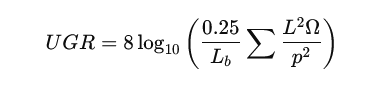
The UGR value is calculated based on the following factors:
Since the UGR value is based on a complex formula and several different parameters, specialized lighting design programs such as DIALux, Relux or other CAD-based lighting calculation programs are often used to calculate it. These programs are entered into:
Based on this information, the program calculates the UGR value in different places of the room and gives an estimate of how disturbing the glare is from different perspectives.
Do you want to hear more? Call us and we'll come to tell you more. Or send an email.
Tel +358 20 792 4240
e-mail: adlux@adlux.fi
Lighting has a significant impact on a company's operations, energy costs and the comfort of the work environment. Many companies postpone lighting renovation due to high investment costs, but financing solutions offer the opportunity to carry out modernization without a large one-time cost. Here are reasons why it is worth financing lighting renovation.
New, energy-efficient LED lighting reduces energy consumption by up to 50–80% compared to old fluorescent or halogen lamps. With a financed solution, a company can immediately benefit from the savings without a large capital investment. Monthly savings on the electricity bill can even cover the financing costs, making the investment pay for itself. By connecting the luminaires to a smart lighting solution, even more savings can be achieved, as the lights are only on where people move.
High-quality lighting improves employee comfort and efficiency. The right lighting reduces eye strain, improves accuracy and reduces errors, which is especially important in industries, warehouses and offices. By investing in financing, a company can quickly upgrade its lighting without financial risk.
Financing models such as leasing or installments allow for investment without tying up capital. This leaves the company with more funds for other business development projects and secures cash flow. Lighting renovation can be implemented without significantly straining the company's budget.
LED lighting reduces a company's carbon footprint and supports sustainable development goals. In many industries, environmental responsibility is a competitive advantage, and modern lighting can help a company improve its image and meet increasingly stringent energy efficiency requirements.
LED lights last significantly longer than traditional light sources, reducing maintenance needs and costs.
A funded lighting upgrade is a smart way to improve a company's energy efficiency, work environment and cost structure without a large initial investment. It enables immediate savings, preserves cash flow and promotes environmental responsibility. By investing in modern lighting, a company creates a competitive advantage and ensures a sustainable future
Reference on investment payback period and financing:

In this example, AD Linear luminaires were installed in the premises, which also have Philips Masterconnect control. With the entire project financed, this means that the investment in the lighting project is practically free.
Do you want to hear more? Call us and we'll come to tell you more. Or send an email.
Tel +358 20 792 4240
e-mail: adlux@adlux.fi
Uudet valonheittimet ovat nyt tilattavissa.
Heittimiä on tällä hetkellä kolme eri teholuokkaa:
Tehot ja ominaisuudet ovat tässä:
LUX 100, teho 110W ja 15.000 luumenia
LUX 200, teho 213W ja 30.000 luumenia
LUX 400, teho 426W ja 60.000 luumenia
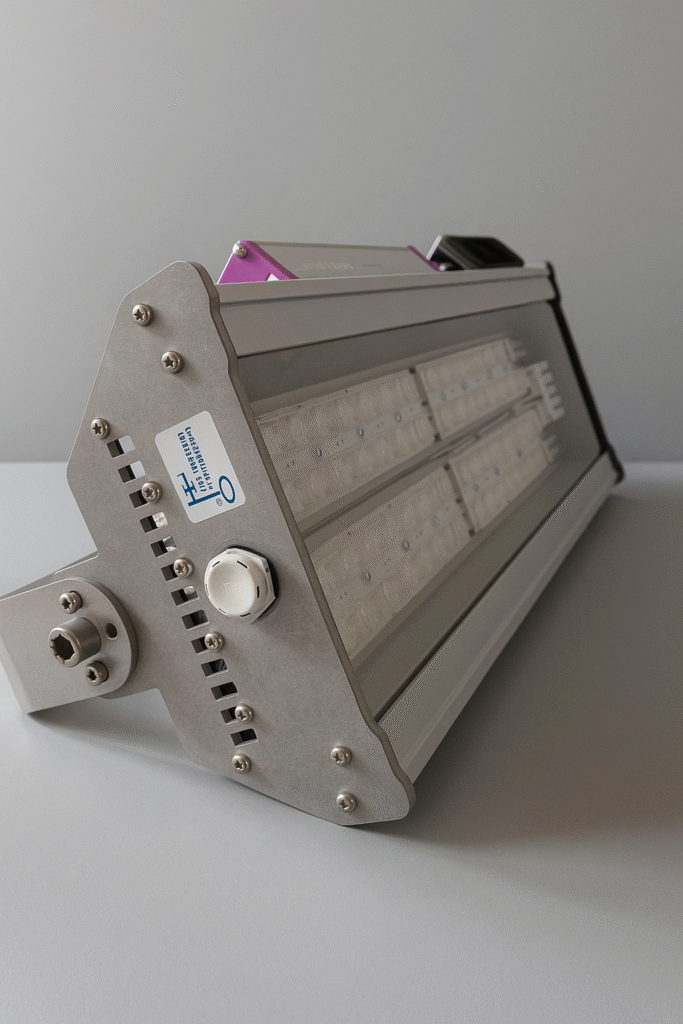
Uudet valonheittimet ovat entistä tehokkaampia ja rakenteeltaan yksinkertaisempia.
Olemme valonheittimien kehitystyöhön saaneet kehitystukea Euroopan Unionilta.



 English
  Finnish